
Every School Serves Differently
5 Questions Every K-12 Foodservice Director Should Ask Before Investing in New Equipment
No two school nutrition programs operate exactly alike.
Every district has its own workflow, menu, staffing levels, facility layout, and service model. While one school may prepare meals onsite and serve them directly from the cafeteria, another may transport food from a central kitchen, operate grab-and-go stations, or serve students across multiple locations.
Because every operation is different, choosing foodservice equipment isn’t simply about comparing specifications. It’s about understanding how your program functions and selecting solutions that help your team work more efficiently while maintaining food quality every step of the way.
At HRI, these are the conversations we have every day with school nutrition directors, consultants, and dealers. That’s why we’re proud to represent FWE (Food Warming Equipment Company), whose K-12 equipment solutions are designed to help schools improve workflow, maintain food quality, and create serving solutions tailored to the unique needs of their operation.
Before investing in new equipment, here are five questions we encourage every K-12 foodservice program to ask.
1. How Does Food Move Through Your Operation?
The first question isn’t about equipment at all. It’s about your workflow.
Think about the journey your meals take each day. Are they prepared and served in the same kitchen? Do they travel between buildings? Are they staged before multiple lunch periods? Do students pick them up from a traditional serving line or a grab-and-go station?
Understanding that journey helps determine which equipment will best support your operation.
FWE approaches K-12 foodservice as a complete workflow, offering solutions for refrigeration, rethermalization, heated holding, transport, serving and staging, grab-and-go applications, and more. This allows schools to select equipment based on how meals move through their operation rather than trying to fit their workflow around standard equipment.
The better you understand your workflow, the easier it becomes to identify equipment that improves efficiency instead of creating unnecessary steps.
2. What Does Your Menu Require?
Not every menu item should be held the same way.
Fried foods, vegetables, proteins, baked goods, and other menu items each respond differently to heat and humidity. Using the wrong holding environment can affect texture, appearance, and overall food quality before students even reach the serving line.
Understanding your menu is one of the simplest ways to narrow down the right holding technology. FWE addresses this challenge by offering multiple heated holding technologies designed for different applications.
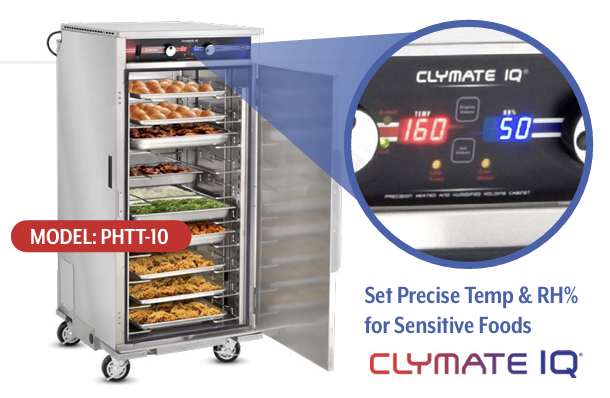
The UHS Series provides gentle heated holding for a wide variety of menu items. Schools serving moisture-sensitive foods can benefit from the MTU (Moisture-Temp Universal) Series, which uses active humidity control to help maintain product quality during extended holding periods. For operations requiring even greater precision, the PHTT Clymate IQ Series independently controls both temperature and relative humidity, helping operators maintain ideal holding conditions for delicate menu items.
Matching your holding equipment to your menu can help preserve food quality, improve consistency, and create a better dining experience for students.
3. Where Will Your Equipment Be Used?
In many schools, equipment rarely stays in one place.
Holding cabinets, transport carts, and serving equipment may move through kitchens, hallways, cafeterias, classrooms, concession areas, or even between multiple buildings throughout the day.
When equipment is constantly on the move, durability becomes just as important as capacity.
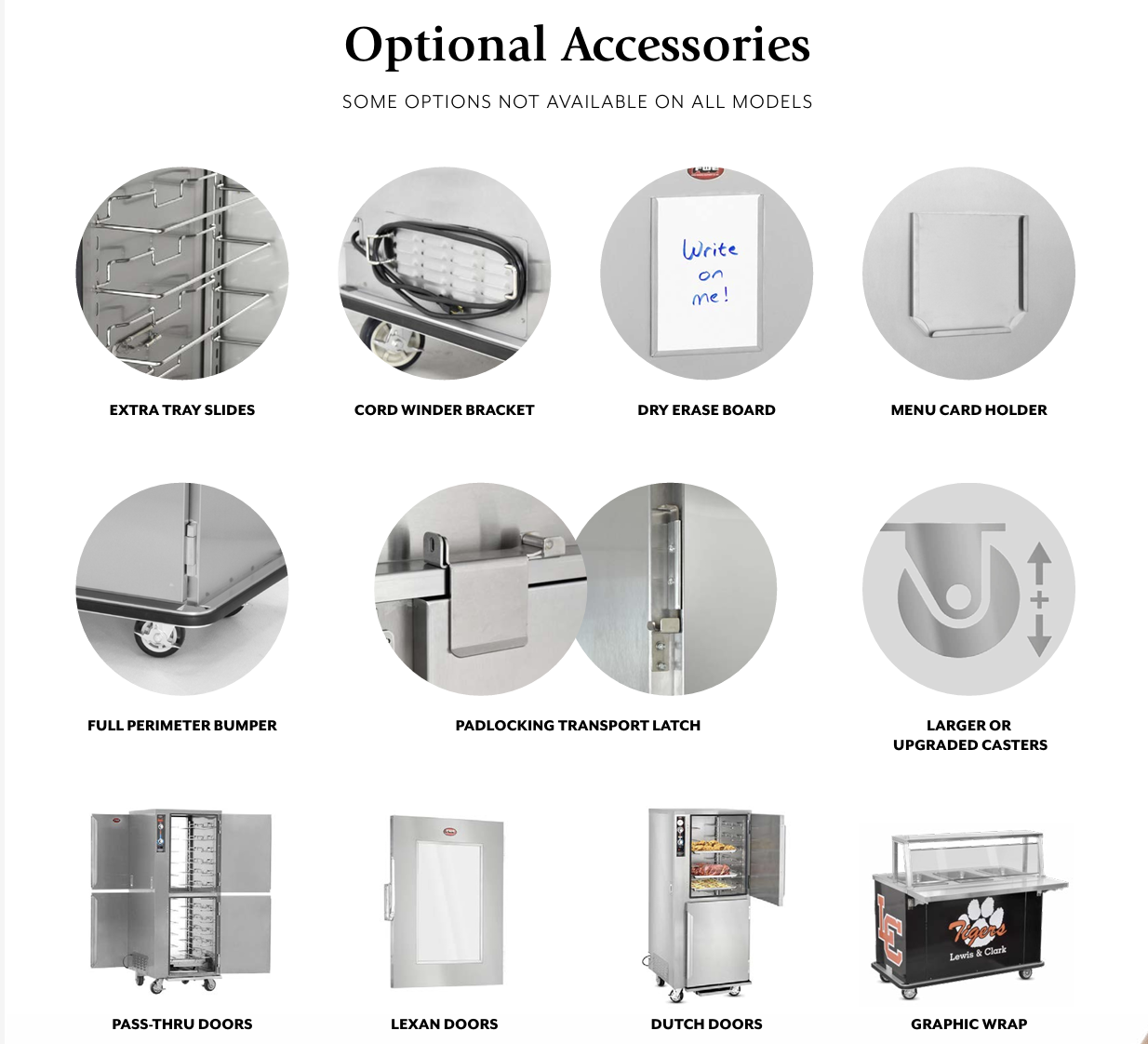
FWE designs its equipment with durability and long-term reliability in mind, recognizing that school foodservice equipment is expected to perform consistently through years of daily transport and service. Many FWE K-12 solutions are engineered with heavy-duty tubular welded base frames, rear push handles, transport-ready construction, and optional full-perimeter bumpers designed to withstand the demands of daily movement. Options such as upgraded casters, transport latches, and configurable tray slides allow schools to tailor equipment to their environment and workflow.
Thinking about where your equipment needs to go each day can be just as important as thinking about what it needs to hold.
4. How Will You Maintain Food Quality Between Production and Service?
For many districts, preparing meals and serving meals don’t happen at the same time.
Whether you’re using centralized production, cook-chill systems, or simply preparing food ahead of a busy lunch period, maintaining food quality between production and service is critical.
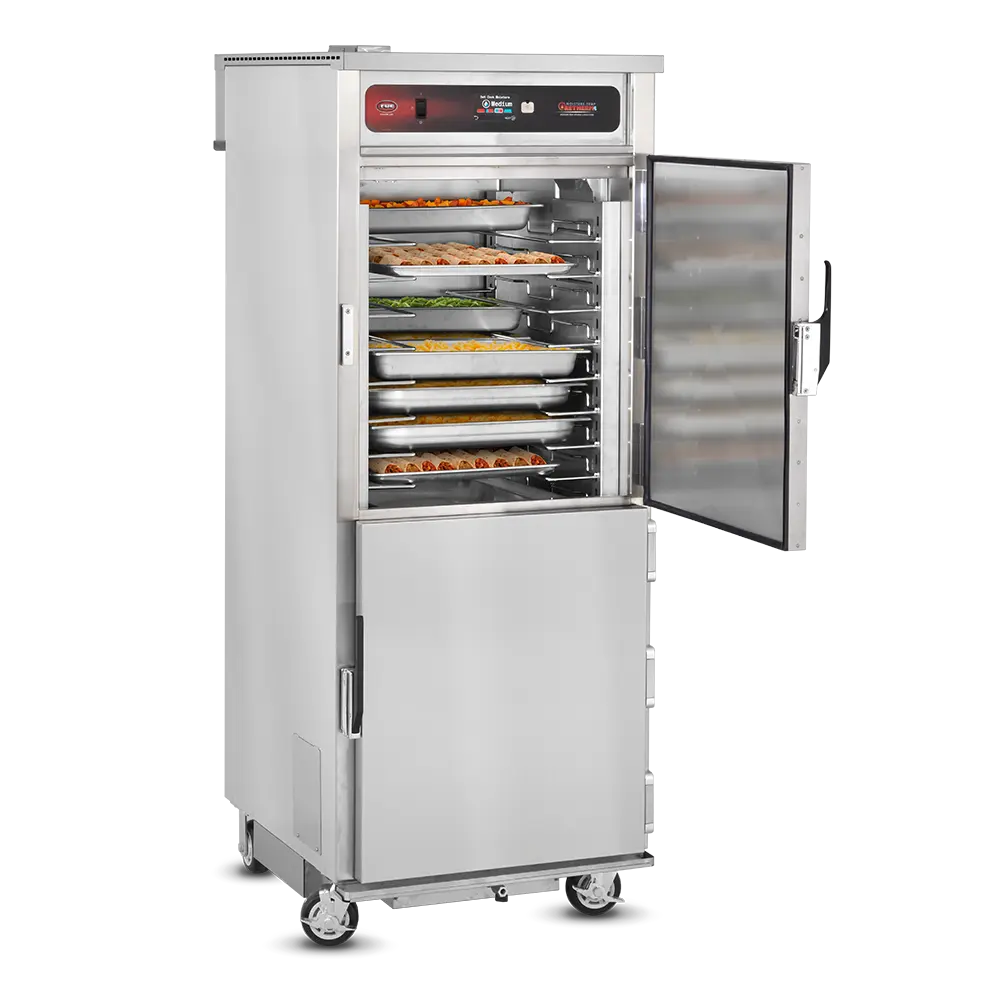
FWE’s RH Series Retherm Ovens are designed specifically for this stage of the process. Using controlled airflow, they rapidly and evenly reheat chilled or frozen meals to safe serving temperatures before automatically transitioning into holding mode. Available in universal tray, basket, and roll-in rack configurations, RH Series ovens help operators preserve flavor, texture, appearance, and food quality while supporting efficient production schedules. Because FWE retherms do not require a ventilation hood under typical installation conditions (subject to local codes), they can also offer greater installation flexibility.
If your operation prepares meals ahead of service, the right retherm solution can help bridge the gap between production and the serving line without compromising quality.
5. Will Your Equipment Meet Your Needs Five Years from Now?
School nutrition programs continue to evolve.
Menus change. Participation fluctuates. Service models expand. Equipment purchased today should be able to adapt alongside those changes.
FWE builds flexibility into many of its K-12 solutions through configurable tray slide arrangements, pass-thru or Dutch doors, menu card holders, graphic wraps, upgraded casters, and other accessories that allow schools to tailor equipment to their operation. Rather than settling for a standard configuration, districts can invest in equipment designed around the way they work today while preparing for future needs.
At HRI, we help schools think beyond today’s purchase by recommending solutions that support long-term operational goals, not just immediate equipment needs.
The Right Questions Lead to Better Equipment Decisions
Every school serves differently, and every equipment decision should begin with understanding the unique needs of that operation.
By asking the right questions before investing in new equipment, school nutrition teams can make informed decisions that improve workflow, maintain food quality, and support students every day.
Whether you’re replacing a single holding cabinet or planning a larger renovation, HRI can help you evaluate your operation and identify FWE solutions that let you truly serve your way—with equipment designed around your workflow, menu, and long-term goals.
Planning a K-12 equipment project? Through September 30, 2026, qualifying school foodservice projects can take advantage of FWE’s “Serve Your Way with No Freight to Pay” promotion, which offers free freight on all standard FWE catalog models and available options for eligible school projects. It’s a great opportunity to maximize your equipment budget while creating a serving line tailored to your school’s unique needs. Contact HRI to learn more about the promotion and find out if your project qualifies.
